

AGI Post Daily Issue #5, June 9, 2026
The Brief
This issue covers four linked feature recaps: Satya Nadella on enterprise AI harnesses, Tyler Cowen on initiative as the deployment bottleneck, Demis Hassabis on the AI decision window, and Alex Imas with Philip Trammell on who owns the upside if AI shifts returns toward scarce assets.
It compresses about 3 hours and 13 minutes of primary source video into a 14 minute daily review.
Features
Satya Nadella on Microsoft's AI Harness Race
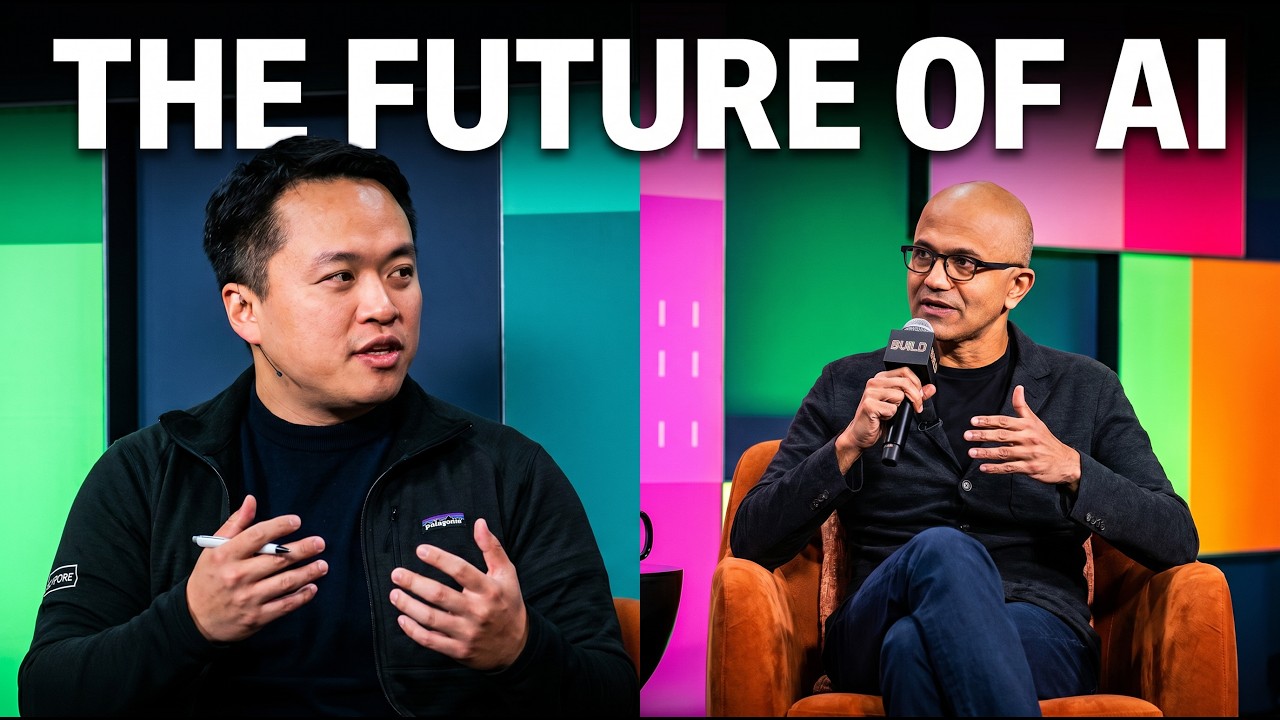
Satya Nadella is explaining Microsoft's Build 2026 AI strategy to Latent Space and No Priors. Enterprise AI value moves into the harness around agents: the operating layer that gives agents company data, tools, context, evals, permissions, interfaces, traces, and human review. Coding agents make the problem obvious. Once a developer or manager has many agents producing work, chat becomes too thin. The company needs a work surface for assigning, inspecting, approving, and improving agent work. Nadella extends that pattern to the whole enterprise: private evals can test whether agents help with company-specific work, traces can show how good work happens, and the harness can improve the system over time. Microsoft wants Foundry, GitHub Copilot, Microsoft 365, Microsoft IQ, and Azure to supply that harness. Customers may own their private evals, traces, and context, but Microsoft is building the platform where those assets become useful.
Customers may own the private evals, traces, and workplace context that make enterprise agents useful, but Microsoft is building the platform where those assets are measured, routed, governed, and put to work. The control question is whether that harness stays portable across models and vendors, or becomes another Microsoft-shaped operating layer.
How AI Makes Initiative Beat Intelligence

Tyler Cowen argues that AI rewards initiative more than static intelligence: the winners are people and institutions that can turn AI into experiments, data, workflow redesign, and action before slow systems catch up.
AI advantage shifts from credentialed mastery of old workflows to fast reallocation of effort, data, and process. The productivity bottleneck is likely institutional absorption, not only model capability. AI politics may be driven by status loss among incumbent professionals even without mass unemployment. Sovereign AI capacity becomes a national allocation problem, not merely a software procurement decision.
Demis Hassabis On The AI Decision Window

Demis Hassabis says AGI may be close enough that the next few years are a decision window. AlphaFold shows a concrete version of AI serving science, while his comments on public concern and regulation show why governance, benefit-sharing, safety, and human agency cannot wait.
Stanford Graduate School of Business uploaded this YouTube conversation on June 2, 2026. Stanford president Jonathan Levin moderated the discussion with Demis Hassabis, co-founder and CEO of Google DeepMind. Google DeepMind is Google's frontier AI research lab. AlphaFold is a Google DeepMind system for predicting protein structures, which helps researchers study biology and disease. Artificial general intelligence, or AGI, refers to AI systems that can perform a broad range of cognitive tasks rather than one narrow job. The conversation covers DeepMind's mission, AlphaGo, AlphaFold, AGI timelines, public concern, AI regulation, global benefit, and student agency.
Alex Imas And Philip Trammell On Owning The AI Upside

AI gains are not automatically shared. Workers, ordinary savers, and poorer countries need exposure to the assets that capture the upside.
Dwarkesh Patel published this YouTube interview on June 4, 2026. The guests are Alex Imas and Philip Trammell. Imas is a professor at the University of Chicago Booth working in behavioral science, economics, and applied AI. Trammell is an economist connected to Stanford's Digital Economy Lab and Epoch, with work on economic growth and AI. The episode is framed as an economics-of-AGI discussion. AGI means artificial general intelligence: AI systems able to perform a broad range of economically useful work rather than one narrow task. The conversation covers labor share, capital share, scarcity, redistribution, demand, machine workflows, and developing-country strategy.