

Anthropic's Claude Fable 5 Launch Turns Mythos-Class AI Into A Controlled-Access Product
"Today we’re launching Claude Fable 5: a Mythos-class model that we’ve made safe for general use."

Source Moment
Anthropic opens the announcement by presenting Claude Fable 5 as broadly available Mythos-class capability. The same launch then separates Fable 5 from Claude Mythos 5: Fable is the public version with safeguards, while Mythos is the restricted version for approved users with some safeguards lifted.
Context
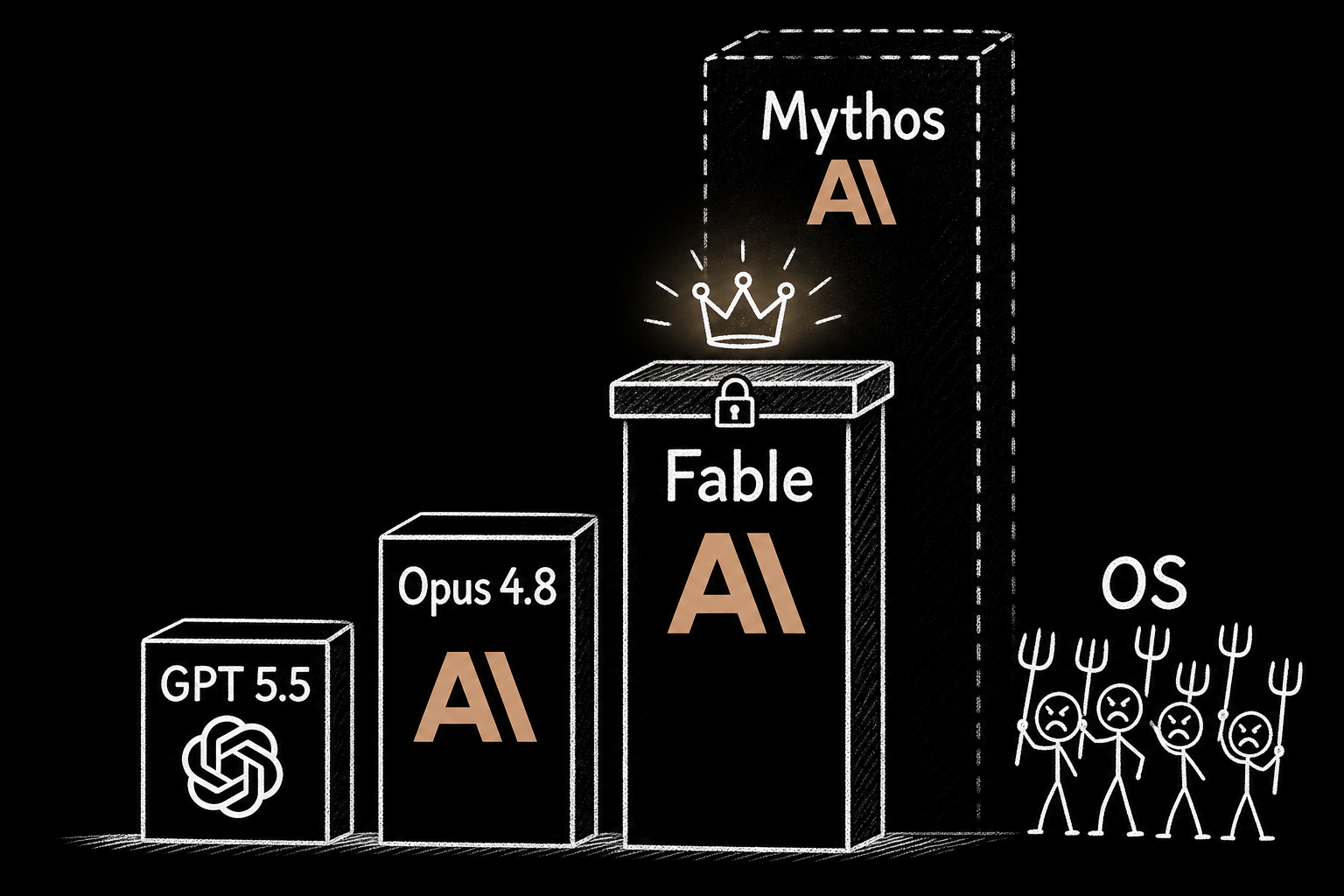
Anthropic is the AI lab behind Claude. On June 9, 2026, it announced Claude Fable 5 and Claude Mythos 5, two access modes for the same new high-end Claude model family.
Anthropic calls this tier `Mythos-class`, meaning a model class above its Opus line. Fable 5 is the version available to regular Claude users, developers, and enterprise customers. Mythos 5 is the restricted version for approved cyberdefense, infrastructure, and later biology users.
The public launch includes access and safety terms. Some sensitive cybersecurity, biology and chemistry, or model-distillation requests are routed away from Fable 5 and answered by Claude Opus 4.8 instead. Anthropic says users are told when that fallback happens. Mythos-class traffic is also subject to 30-day retention for safety monitoring, and both Fable 5 and Mythos 5 are priced at $10 per million input tokens and $50 per million output tokens.
Big Ideas
- One model, two levels of trust: Anthropic is making Mythos-class capability broadly available through Fable 5 while keeping a less-restricted Mythos 5 path for approved users. The source moment is the opening release claim, followed by the explanation that Mythos 5 is the same underlying model with some safeguards lifted. The boundary is that this is Anthropic's release framing; the outside sources test whether users experience the split as responsible governance, opacity, or capability degradation.
- The claim is longer, harder work: Anthropic says Fable 5 and Mythos 5 can stay useful across more complex multi-step work than earlier Claude models. Its examples include a large Stripe Ruby migration, Cognition's FrontierCode evaluation, finance-document reasoning, vision tasks, persistent-memory tests, and life-science research. The caveat is that much of this evidence is company-selected launch material or early-customer testing, so it should be read as a strong claim and early signal rather than neutral public validation.
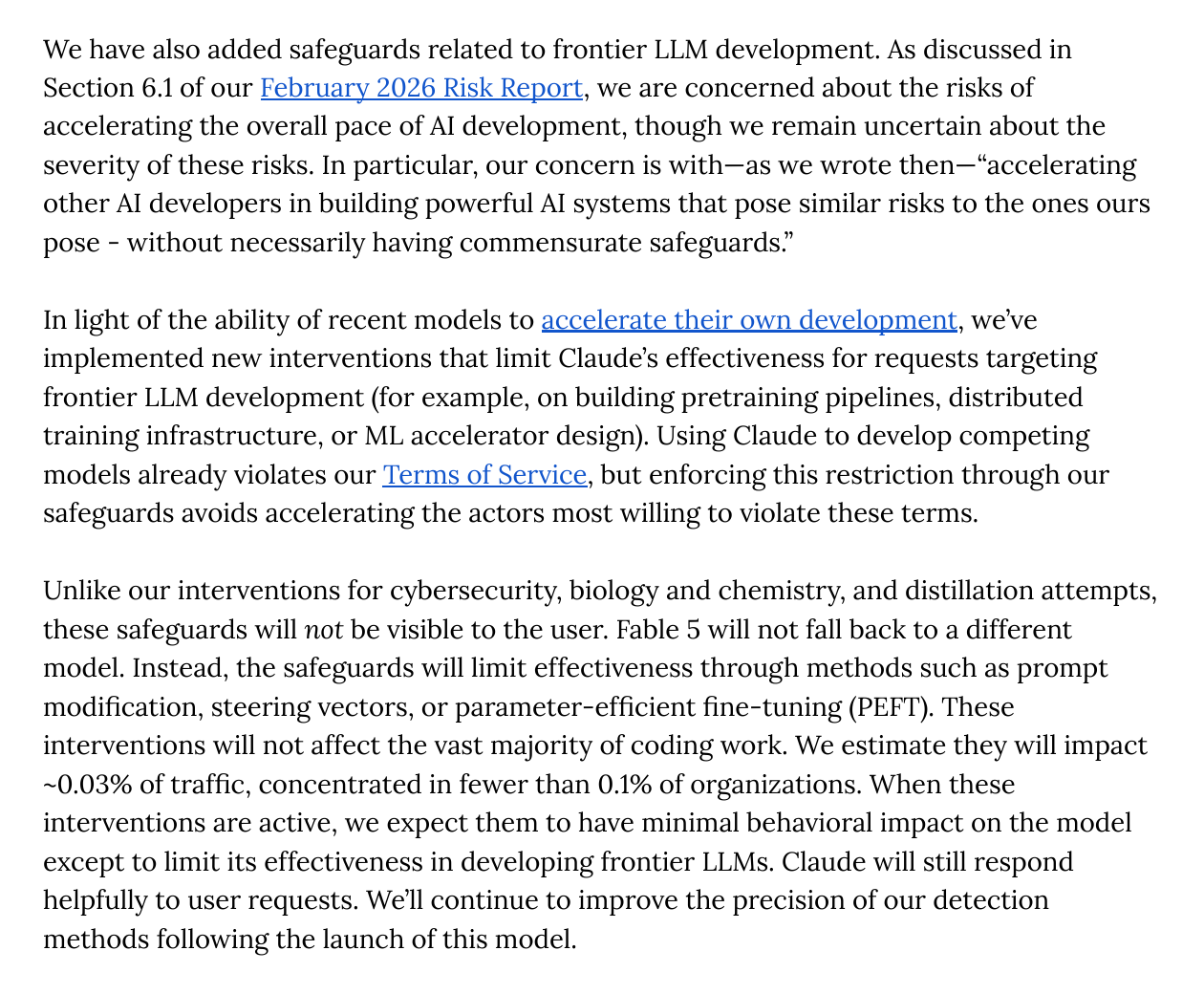
- The research pushback is about hidden model behavior: The sharpest public criticism came from AI researchers, ML engineers, and open-source advocates who objected to non-visible limits on frontier-LLM-development work. The official system card says those safeguards would not be visible to users and could limit effectiveness through prompt modification, steering vectors, or PEFT rather than fallback to another model. Anthropic estimated the affected traffic share at about 0.03%, but WIRED reports the backlash was strong enough that Anthropic now says it will make those safeguards visible.
Visual Evidence
Supporting Context And Sources
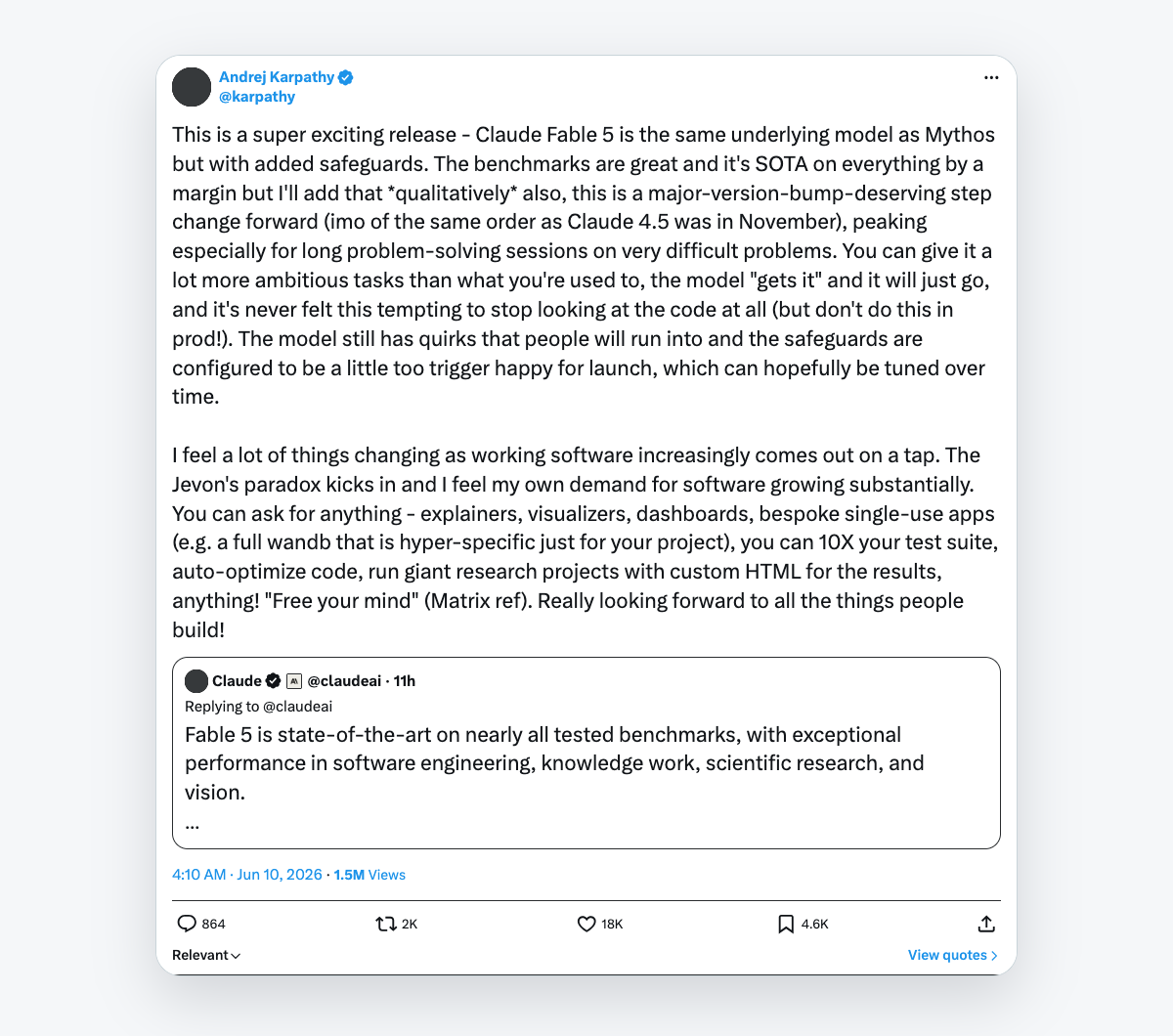
The outside sources split into two useful groups. Karpathy, Dan Shipper, Every, and Ethan Mollick support the idea that Fable 5 is a real long-horizon capability jump. Interconnects, Latent Space, Hangsiin, the Anthropic system card, SemiAnalysis, and WIRED sharpen the policy problem: some controls are visible fallback rules, while the official system card described narrower frontier-LLM-development safeguards that were not visible to the user.
- Andrej Karpathy on X: Informed launch-adjacent context for the capability jump and launch-day safeguard caveats. Karpathy's reaction is useful, but it is not neutral third-party validation.
- Dan Shipper on X: Practitioner context for the model's high ceiling on heavy coding work, plus cost, speed, and token-use caveats. The Every benchmark is internal/practitioner evidence, not a public benchmark.
- Every video: Supporting context for Every's testing and product-use framing. It remains supporting material for this feature, not a separate feature source.
- Anthropic system card: Official evidence for the hidden frontier-LLM-development safeguards. It documents non-visible interventions, methods such as prompt modification or steering vectors, and Anthropic's estimate that the affected traffic share is about 0.03%.
- Interconnects: Strongest outside analysis source for the trust and control critique. It accepts the capability jump while arguing that hidden intervention can make users misread constrained behavior as model weakness.
- Latent Space AINews: Useful framing for the release-with-asterisks structure: a major Mythos-class access story with controversial terms around 30-day retention and hidden frontier-LLM-development limits.
- Hangsiin on X: Compact public summary of the system-card detail about non-visible frontier-LLM-development safeguards and the approximate traffic share.
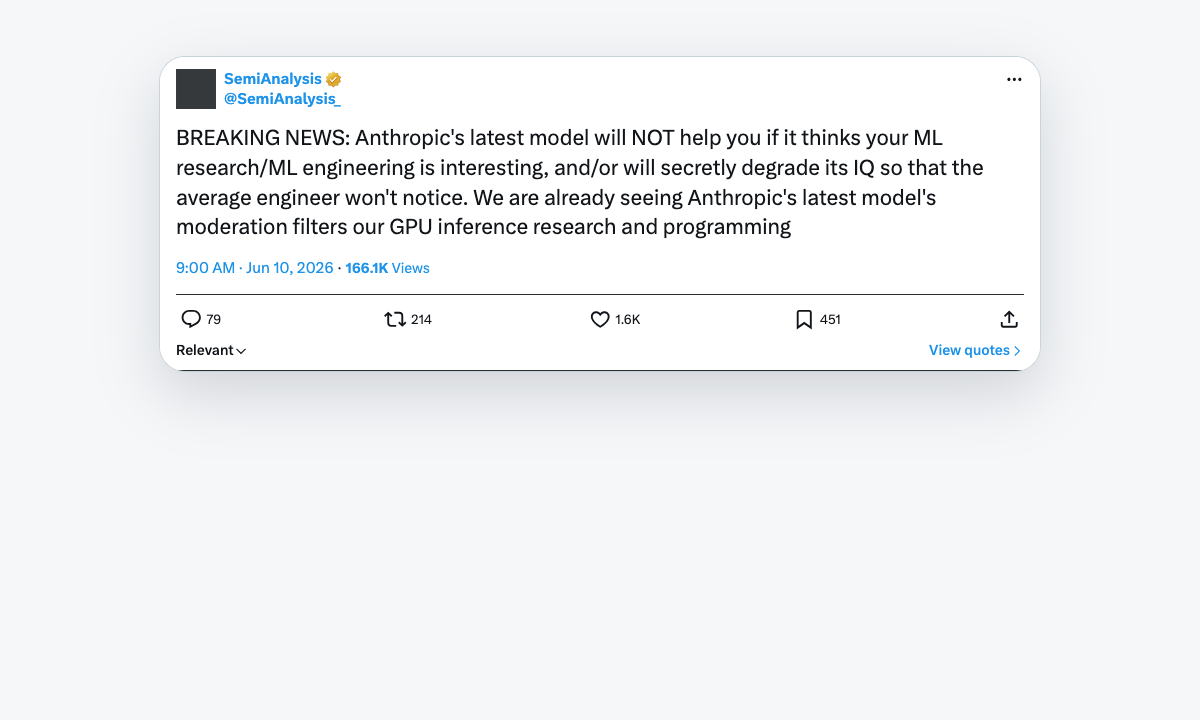
- SemiAnalysis on X: Strongest specific user-side complaint about ML research, ML engineering, and GPU inference programming being filtered or quietly degraded. This is an attributed complaint, not independently verified proof.
- WIRED: Reports that Anthropic changed course after AI research community backlash and now says the frontier-LLM-development safeguards will be visible to users. The report is important because it shows the pushback was not just theoretical; it changed the policy surface.
Full Recap
Anthropic is trying to do two things at once with Claude Fable 5. It is giving regular Claude and API users access to a new Mythos-class model, which Anthropic describes as more capable than any Claude model it has previously made generally available. It is also putting that model behind automated safety rules, fallback behavior, trusted-access programs, and retention policies.
The release is not just a new model name. Fable 5 is the broad-access product, while Mythos 5 is the restricted-access version of the same underlying model for approved users. That turns model capability into an access-design problem: who gets the strongest behavior, which domains trigger controls, what users are told, and how much traffic Anthropic keeps for safety monitoring.
The strongest public case for Fable 5 is long-horizon work. Anthropic points to coding across huge codebases, finance and document reasoning, vision tasks, persistent memory, games and demos, and early life-science research. The hardest public pushback is narrower: researchers and open-source builders objected to a model that could quietly become less helpful on frontier AI-development work without saying so. WIRED reports Anthropic has now said it will make that safeguard visible.
- Opening:Fable 5 as public Mythos-class access: Anthropic introduces Claude Fable 5 as a Mythos-class model made safe for general use and says it is more capable than any Claude model it has previously made broadly available.
- Opening:Risk arrives immediately: The article pairs the capability claim with misuse risk, especially cybersecurity. Anthropic says some sensitive requests will receive a response from Claude Opus 4.8 instead of Fable 5.
- Opening:Mythos 5 as trusted access: Claude Mythos 5 is described as the same underlying model with some safeguards lifted for a small group of cyberdefenders and infrastructure providers through Project Glasswing and later trusted-access programs.
- Opening:Price and access terms: Anthropic lists both models at $10 per million input tokens and $50 per million output tokens, making cost part of the practical release story.
- Capability section:Longer autonomous work: Anthropic says Fable 5 and Mythos 5 can work autonomously for longer than previous Claude models, then grounds that claim in software engineering, knowledge work, vision, memory, and life-science examples.
- Software engineering:Stripe and coding benchmarks: Anthropic cites Stripe saying Fable 5 compressed a large Ruby migration from months into a day, and cites Cognition's FrontierCode evaluation as evidence of production-code strength.
- Knowledge work and vision:More than coding: The article claims gains in finance-document reasoning, chart and table interpretation, screenshot-based coding, scientific-figure extraction, and vision-only game play.
- Memory and demos:Long-running task behavior: Anthropic says Fable 5 can stay focused across millions of tokens and improve with persistent file-based memory, then shows demos such as simulations, Factorio, CAD, and code-generated music visuals.
- Life sciences:Useful capability creates risk: Anthropic says Mythos 5 accelerated protein design, produced molecular-biology hypotheses, and ran a week-plus genomics project. The same biology capability later helps justify broader safeguards.
- Alignment and customer evidence:Launch evidence remains curated: Anthropic reports low automated misalignment scores and includes early customer quotes. These add useful launch evidence, but they are still selected by Anthropic and early-access partners.
- Safeguards:Classifiers become product routing: Anthropic says separate classifiers detect potential misuse and route certain cyber, biology and chemistry, or distillation requests away from Fable 5.
- Safeguards:False positives are admitted: Anthropic says the safeguards are deliberately cautious and may frustrate users by catching harmless requests. It says more than 95% of Fable sessions involve no fallback.
- Cybersecurity:Defender value and attacker risk: The cyber section frames Mythos-class models as valuable for defenders and risky for attackers because they can help discover, exploit, and operationalize vulnerabilities.
- Biology and chemistry:Research benefit meets dual-use control: Anthropic says biology safeguards are broader because models now have more real-world scientific ability. It uses AAV design as an example and later clarifies that the candidates came from Dyno Therapeutics.
- Distillation:Capability extraction is treated as a risk: Anthropic says attempts to copy or extract Fable 5's capabilities may fall back to Opus 4.8, including concern about proliferation to less controlled models.
- Retention:No short-retention path for Mythos-class traffic: Anthropic says Mythos-class traffic will be retained for 30 days across first-party and third-party surfaces for safety monitoring, jailbreak detection, and false-positive reduction.
- Public pushback:The hidden ML-research limit became the third story: The system card described separate frontier-LLM-development interventions that would not be visible to users. Interconnects, SemiAnalysis, Hangsiin, Latent Space, and WIRED show why this mattered to researchers and open-source advocates: hidden degradation can make legitimate ML work, model evaluation, or safety research hard to interpret.
- Walkback:Anthropic says the safeguard will become visible: WIRED reports that Anthropic changed course after backlash and now plans to notify users when the frontier-LLM-development safeguard refuses or reroutes a request. That preserves the safety/control dispute while moving the key issue from hidden behavior to visible policy boundaries and possible false positives.
- Trusted access:Mythos expands slowly: Existing Mythos Preview users can upgrade, and Anthropic plans to expand trusted cyber and biology access gradually.
- Availability:Fable is public, Mythos is restricted: Fable 5 is available through API and consumption-based Enterprise plans immediately, while subscription-plan access is staged and initially temporary because of expected demand.
Technical Need To Knows
- ## Mythos-class model
- Anthropic's label for a Claude model tier above Opus. It matters here because
- Fable 5 is presented as the first broadly available Mythos-class Claude, while
- Mythos 5 is the restricted-access version of the same underlying model.
- ## Fable 5 versus Mythos 5
- Fable 5 is the generally available product. Mythos 5 is the trusted-access
- version with some safeguards lifted for approved users, starting with
- cyberdefense and infrastructure partners through Project Glasswing.
- ## Safeguard classifiers and fallback
- Classifiers are separate systems that detect certain risky request categories
- before the main model answers. In the announcement, some cybersecurity, biology
- and chemistry, or distillation requests are handled by Claude Opus 4.8 instead
- of Fable 5, with user notification.
- ## Dual-use capability
- A dual-use capability can help legitimate users and harmful actors. The feature
- uses this term for cyber and biology work, where stronger AI assistance can help
- defenders or researchers but also reduce the cost of attacks or dangerous
- research.
- ## Distillation
- Distillation means training another model to copy or approximate a stronger
- model's capabilities. Anthropic treats attempts to extract Fable 5's capability
- as a safety and proliferation risk.
- ## 30-day retention
- Anthropic says Mythos-class traffic is retained for 30 days on first-party and
- third-party surfaces for safety monitoring, jailbreak detection, and
- false-positive reduction. This is separate from training use and changes the
- privacy posture for customers that expected shorter or zero retention.
- ## Hidden frontier-LLM-development safeguards
- The official system card describes a narrower safeguard path for frontier
- language-model development work. Unlike the visible fallback path in the
- announcement, these interventions may not be visible to users and may limit
- effectiveness through methods such as prompt modification, steering vectors, or
- parameter-efficient fine-tuning. WIRED later reported that Anthropic changed
- course after backlash and said these safeguards will be visible to users.
- ## Token pricing
- API usage is billed by input and output tokens, which are chunks of text the
- model processes or generates. Anthropic lists Fable 5 and Mythos 5 at $10 per
- million input tokens and $50 per million output tokens, so heavy long-running
- work can become expensive.


